by Zabaan | May 27, 2015 | Ancient Greek, Classical languages, Script
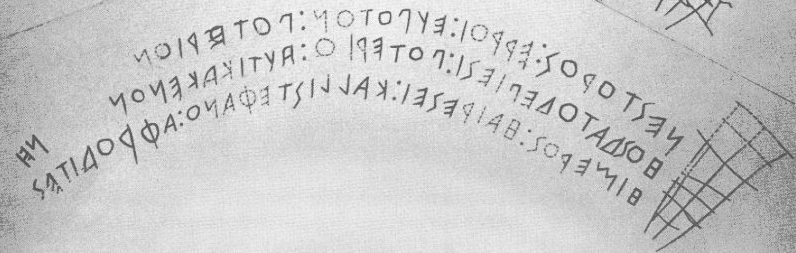
Νέστορος [εἰμὶ] εὔποτ[ον] ποτήριο[ν]· ὃς δ’ ἂν τοῦδε π[ίησι] ποτηρί[ου] αὐτίκα κῆνον ἵμερ[ος αἱρ]ήσει καλλιστ[εφάν]ου Ἀφροδίτης. “I am Nestor’s cup, good to drink from. Who happens to drink of this vessel, forthwith the desire of fair-crowned...
by Zabaan | May 27, 2015 | Etymology
Copain in French means mate. The word consists of co-, meaning together (as in coworker), and pain, the French word for bread, making a mate a person with whom one shares a meal, one’s daily bread. The word company has the same...
by Zabaan | May 26, 2015 | Ancient Greek, Classical languages, Etymology
The word amazon is of Greek origin and is not a really an exotic tribal name, but pure and simply a descriptive term. It consists of the privative prefix a- (as in a-theist) and the noun mazos meaning breast. It alludes to the popular belief that Amazons cut of their...
by Zabaan | May 26, 2015 | Classical languages, Etymology, Old Norse
Parts of England were occupied by Old Norse speaking vikings between 860 and 950 AD. In this time many Old Norse words were borrowed into English, sometimes these words are surprisingly common in today’s English. Sky, anger and window, for example, are all of...

by Zabaan | May 25, 2015 | Literature
Ancient Germanic smiths used a technique known as pattern welding, by which a blade was forged from several rods twisted and hammered together when in fusion. This process not only makes the resulting blade stronger, but it also gives it a very distinctive patterned...